September 16, 2010

"Whiskey's for drinking; water's for fighting."

Los Angeles lives on the water it imports from Northern California and the Colorado River. California is expected to add millions of new residents over the next couple decades, many of which are likely to reside somewhere in Southern California. Constrained resources and rising demand make our reliance on imported water unsustainable. Also, transporting water is incredibly energy intensive. According to some estimates, 20% of California's carbon dioxide emissions result from pumping water throughout the state.

Some people are already thinking about to how reconcile the demand for growth and development with the environmental, economic and social imperative to build sustainably. A recent article by Metropolis Magazine discusses the nexus between water and sustainability. The article culminates in a call to action for those interested in designing a sustainable vision for our cities:

"The Living City Design Competition calls on the world’s most ambitious designers to create an inspiring but realistic vision for the future of civilization. Competition teams will conceptually retrofit existing cities, demonstrating how real communities might transform their relationship with the resources that sustain them. These re-imagined cities must achieve each Imperative of the Living Building Challenge, the built environment’s most rigorous performance standard.

To be certified under the Living Building Challenge, a project must capture and treat all of its own water onsite using ecologically sound processes. It must also ensure that 100% of storm water and building discharge feeds the project’s internal water demands or is released onto adjacent sites for management through gradual surface flow, groundwater recharge, agricultural use or adjacent building needs."
Los Angeles River
The challenge to have no net import and no net export of water within a given site is the ultimate metric for water sustainability and ought to be the goal for all buildings in the Los Angeles region. There is no reason why resources and money should be spent to send rainwater out to sea when it could be harnessed for more productive uses, thereby eliminating the need for the costly and damaging practice of importing water.

September 13, 2010

Getting Past Semantics

The term "sustainability" as a planning concept is vague and poorly defined. Understanding what it means and how best to harness its principles to craft a more positive urban experience have been undermined by our lazy use of language. Bill Barnes from the National League of Cities made a similar point recently, correctly pointing out that the term "sustainability" has been thrown around so freely that we don't really know what we're talking about any more. Discussions about green building, LEED, mass transit, TOD, etc. make it seem as though sustainability is everything. But if it is, then maybe it's nothing? Clearly that's not the case either but to better understand how sustainability impacts planning and our collective vision for the built environment, we need to do a better job defining the terms of the debate. That is the mission of this blog - to provide an open platform for discussing the sort thinking and development that embody and express the core principles of a sustainable built environment.

September 8, 2010

Zoning a Post-Modern Metropolis

The first major revision of Los Angeles’ zoning codes were introduced recently to the Planning Commission. The goal, according to an article by the Architect’s Newspaper, is to create consistent timelines for land-use approvals; make zoning review more flexible and consistent; allow for abbreviated review processes for minor deviations from the zoning code; create consistent procedures for modifying existing projects; and streamline zoning approval for projects that meet specific plan standards. A final vote is expected before Thanksgiving.

This project reaffirms planner’s modernist belief in the efficacy of zoning and its usefulness as a way of creating order from chaos; the primary tool for planners to rationalize complex urban problems and diagnose well-packaged solutions. The problem is that Los Angeles is continuing to use a decidedly modernist way of thinking in a post-modern world.
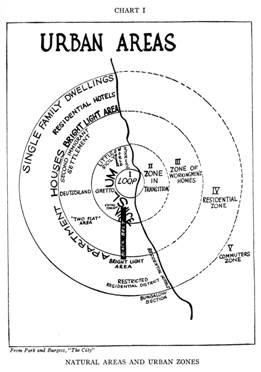
Concentric Zone Theory Model
Post-modernism breaks down the hegemony of modernist rationality, allowing for multiple and equally privileged ways of experiencing and understanding cities. The transition to postmodern thought has been accompanied by a similar shift in the production of cities; the Chicago School’s modernist view of urban structure with a central core organizing the hinterland, characterized by the concentric zone theory, has given way to a postmodern view that replaces modernism’s center city logic with multiple logics all happening at the urban periphery and a breakdown in the distinction between inter- and intra-urban structure.

The Los Angeles School introduced the idea that Los Angeles is the archetype of postmodern urbanism whose patterns of urban growth and change carry explanatory power for cities beyond the five county metropolitan region. Joel Garreau made the same point in Edge City, “every American city that is growing is growing in the fashion of Los Angeles.” The physical manifestations of postmodern urbanism are visible in LA and so the city is a useful lens for examining the principle dynamics of contemporary urbanization and their impact on planning practice. The multiple logics (re)produced by de-centered growth, poly-nucleation, and sprawl all come home to roost in Los Angeles.

The essential problem is that planners (and the current re-write of LA’s zoning code) are currently ill equipped to deal postmodern urbanism, regardless how well they may understand its principle dynamics. The cityLAB manifesto of founding director Dana Cuff and her colleagues captures the essence of the problem:

"Transformations of the city exceed our ability to control them … we arrive at results seemingly by fast-forward, without clear grasp of how we got there. Though not necessarily temporally fast, change occurs as a set of discontinuous jump cuts: urban development is not progressive, but it can never turn back; design is increasingly regulated without ever showing improvement."

The rational ordering of cities from core to hinterland no longer applies. Current planning practice with its emphasis on process, technocratic analysis of things like ridership projections for mass transit, and shift away from the state and toward civil society is overwhelmed by more than just the pace of development; the practice of planning itself appears incapable of articulating and implementing a vision for the future of postmodern cities.
Where's the center here?
Planning has always been about responding to contemporary urban trends, beginning with the challenges posed by late-nineteenth century industrial cities, and must now reclaim some of its progressive, reform tradition in order to remain relevant in a postmodern age. To begin, planning must be self-aware and realize that objective rational argument, critique, and morality are not possible in a postmodern world. It would be irresponsible for planning to assume that it could continue to appeal to a rational logic, like strict Euclidean zoning, for making the built environment a better place when the principle dynamics creating and changing cities today are unresponsive to such an approach.

August 23, 2010

Reading Place


Masdar in Abu Dhabi
I just came across an interesting piece from the blog myurbanist on "reading the evolution of place." The author articulates his message through a brief analysis of eleven pairs of images of various places throughout the world, mostly cities.

Some of his commentary is insightful and strikes at the core of what this blog is trying to accomplish: establishing a new contextually sensitive discourse, systemic and holistic in scope, about sustainability and what it means for the future of the Los Angeles region.
Barrios of Caracas, Venezuela
"Today, we are driven by a new sustainability ethic, necessarily systemic in scope. Carbon-neutrality is the rage, and location efficiency, clean energy and the return of neighborhood are the watchwords of change. Formulas and metrics, and new regulatory systems attempt results, and show the quest to measure how close we are to achieving ideal forms of location and development.

But...context is key, and adaptation to a multi-environmental sense of place, associated imagery and sensation is an essential element of building design, urban development and innovation going forward. Creating beautiful buildings that are able to work for the environment, or crafting appropriate enabling regulations, should also be considered as part of a broader, holistic effort. There is no use in having architects, urban planners, developers and lawyers thinking in isolation about a better future."
Street in Valletta, Malta
His last point about a "broader, holistic effort" is usually directed at our understanding of the environment; a point mentioned to underscore the importance of thinking of the environment in its entirety, rather than as discrete systems. However, I think he's talking about something slightly different and less obvious - that in order for place to be legible in the "sustainable city," architects, urban planners, developers and lawyers need to think and work together. Sustainability is just as much about environmental outcomes as it is about process and collaboration. Without a sustainable practice for producing the sort of urbanism our cities and environment demand, we are never going to make progress toward carbon-neutrality, water independence or any other pressing environmental issue. This is true for Los Angeles just as much as it is for any other big city.

August 21, 2010

What will LA look like in 2030?

Rending: Michael Maltzan Architecture

Given constrained natural resources and accelerating ecological degradation, environmental sustainability is imperative but has yet to present itself on the urban landscape as a principle element affecting the de-centered growth of contemporary cities like Los Angeles. Nevertheless, in the absence of national leadership, cities are trailblazing new multi-scalar sustainability initiatives and greenhouse gas reduction strategies in order to stave off environmental disaster. The influence of these efforts on urban form is yet to be seen but some of ideas proposed by cityLAB-UCLA, Gensler and Michael Maltzan Architecture for what Los Angeles will look like in 2030 give us a glimpse of what a more socially and environmentally conscious urbanism may look like. Their proposals are part of Newsweek Magazine's series about the Future of Work.

Each of the three entrants framed their discussion of the future of LA around four parameters: home, work, commute and recreation. Each offering differing perspectives and intriguing renderings of a possible but as yet unrealized future. The dynamic interaction of natural systems, infrastructure, housing and people holds tremendous promise for the future of Los Angeles. Clearly there doesn't seem to be any shortage of good ideas. The key at this point is trying to figure out how we get from here to there.

August 11, 2010

CicLAvia - UPDATE - 10/10/10

The route is still basically the same, though a few changes through downtown are being made, but the date has been pushed back by nearly one month. The new date for Los Angeles' first ciclovia is October 10, 2010. Be sure to check for updates at CicLAvia's website.

August 4, 2010

LA River - The Spine of the City

There's been a lot of positive press about the LA River recently. GOOD and the LA Times ran stories recently discussing the EPA's decision to officially designate the LA River a "traditional navigable waterway," which apparently paves the way for federal money to be put toward restoring the river to a semi-natural condition. This is great news and a positive first step to undo the concrete channelization of the river and realize the potential of the waterway put forward by the LA River Master Plan.

And projects like the one on Elmer Avenue in Sun Valley (part of LA's Green Streets Initiative) will enable the naturalization of the LA River to occur by capturing and retaining stormwater on-site, reducing peak flow in the river channel during heavy storm events. Greening LA's streets also holds tremendous potential for reducing the city's reliance on distant sources of water. Local acquifers could be replenished through on-site stormwater retention techniques, making more water locally available for use. (note: about 19% of California's carbon dioxide emissions come from pumping and transporting water throughout the state).
Model of a proposal to redevelop an existing train yard into open space and housing.

A much bolder plan to naturalize a portion of the LA River was unveiled last month. Friends of the LA  River (FoLAR), together with a team of advisors, put together a proposal to turn 130 acres of industrial land into a verdant development with open space, housing, commercial and retail thoughtfully integrated into a lush riparian setting that reconnects the landscape with the existing fabric of the city. It's a bold proposal sure to draw fire and attention from all sides. At first glance, it appears to kiss the ring and pay homage to the easiest to achieve and least controversial principles of sustainability. A more critical assessment will have to wait until the details of the project become clearer but for now it's focus on water, neighborhood connectivity, transit, mixed-uses, recreation, open space and agriculture is comprehensive in scope and holistic in approach. A laudable project to be sure. There is plenty more to read here and I encourage you to do so. Become involved in the discussion by commenting on their site or this blog.

July 17, 2010

Measure R and TOD

Rendering for Expo Line's Vermont Station near Exposition Park and USC.
The NY Times wrote recently about the under construction Expo Line, scheduled to open as soon as next summer, and how it is already spurring transit-oriented development.

Los Angeles consistently earns the dubious award for worst traffic congestion in the US. The reasons for congestion in Los Angeles are complex, but the salient point is that most of the city’s residential, commercial, and retail districts were built for people coming and going by car. Few areas of the city are capable of supporting non-auto dependent lifestyles. To rectify this situation, and fight congestion and air pollution at the same time, the city is investing heavily in new transit lines like Expo via Measure R, a voter approved sales tax increase that will raise $30 billion for eleven new rail lines and extensions over the next thirty years.

Los Angeles’ existing transit network of 71 stations and 100 miles of track, coupled with the additional infrastructure investments provided by Measure R, represent the city’s best chance for creating dense, affordable and non-auto dependent communities. There is tremendous potential for Los Angeles to leverage its existing transit network, Measure R and demand for transit-oriented development as the starting point for improving mobility, building community and achieving regional sustainability. Simply building more roads and more parking to accommodate ever more cars is unsustainable and unhealthy. And without much remaining empty land (besides remote desert valleys) the City has little choice (if it wants to grow sensibly) to concentrate growth and vitality around transit stations.

July 13, 2010

Revisioning the San Fernando Valley

I came acroos two interesting news stories this past week. The first is from The Planning Report online, which discusses the recent formation of the San Fernando Valley Council of Governments, and the other is a video from TED.com by Ellen Dunham-Jones about retrofitting suburbs into more vibrant and sustainable communities.

Bringing together elected officials and planners in the SFV under one umbrella is sure to benefit the region as it plans for continued economic and demographic growth in the coming years. The SFV not only functions as its own region, but it is also part of the larger LA-metro region covering five counties and roughly 15 million people; this reality must be taken into consideration for any planning efforts to be successful. The formation of a SFV COG is a positive first step. Just look at how coordinated lobbying, planning and political pressure worked in the San Gabriel Valley - Metro broke ground just last month on a 12 mile "foothill extension" of the the Gold Line, scheduled to open for revenue service in 2014.

Numerous SFV-regional issues come to mind that deserve attention and coordinated planning: the headwaters of the LA River begin in the western SFV, the Orange Line (which many want converted to light rail) traverses the basin and is being extended north to the Chatsworth Metrolink Station and at least one California High Speed Rail station has been promised for the Valley. The SFV COG will prove its worth if it can manage to leverage these resources effectively to reorient growth and development away from the automobile and toward a more just and sustainable future. We need not reinvent the wheel to make this happen, for really good plans, like the LA River Master Plan, already exist; we just need the political and financial support to make it happen.

For additional ideas about how to reinvent suburbia, which is an apt characterization of much of the SFV, watch Ellen's 20 minute video (link above). Land in LA is at a premium and taking advantage of all the underutilized parcels and parking lots in the SFV represent an enormous untapped resource for capturing growth within the city's existing urban envelope. Some may fight any increase in density but few attractive alternatives remain in our increasingly resource constrained world.

July 8, 2010

Planning Vacancy Opens Door for Innovation

City of Los Angeles Planning Director Gail Goldberg announced her retirement recently, which has been covered by numerous sources. Here are two good articles that talk about her impact on planning, the city and opportunities for future innovation now that she's leaving: LA Times and more from The Architect's Newspaper.

The LA River Master Plan and construction of dozens of miles of rail via Measure R are two of the most obvious opportunities for LA to remake itself in the coming years. Time will tell how the City's new planning director will manage these opportunities while integrating principles of sustainability. In many ways, without any clear direction about how LA ought to grow sustainably over the coming decades, there is a real chance for the new director to put their imprint on the issue and begin to frame the debate.

What would you like to see LA's new planning chief do? What advice would you offer to the incoming planning director? How do you think they should define "sustainability" for the city?