December 20, 2010

Integrating Sustainability into Bus Shelter Design

Bus stations provide an open platform for layering multiple sustainable technologies in a single location. Installing photovoltaic panels on top of bus shelter canopies is one of the most common practices of sustainable bus shelter design. Some cities are also beginning to explore the possibility of using bus shelters to capture and manage storm water.
Solar-powered bus shelter in San Francisco
San Francisco is in the process of rolling out 1,100 new bus shelters that use roof top solar panels to run lights and power an on-site wifi network, which has the potential to provide significant coverage when expanded citywide. The creative repurposing of bus shelters as a platform for advancing environmental and social sustainability goals holds tremendous promise and is an area that is likely to see further innovation, particularly as bus rapid transit lines like the Orange Line (and future Wilshire Line) continue to attract riders.
Solar panels on bus shelter canopy in San Francisco
To understand the potential for leveraging bus shelters as a way to advance sustainability in Los Angeles, consider that Metro operates 15,967 bus stops throughout its service area. If the transit authority built bus shelters similar to those being used in Corona, which use roof top solar panels to feed 1,748 kilowatt-hours of electricity per year into the grid, it could generate roughly 27,910,316 kWh per year of energy. That's enough energy to power approximately 4,560 homes.

15,967 bus stops x 1,748kWh/bus stop = 27,910,316 kWh
27,910,316 kWh/6,120 kWh per LADWP res. customer = 4,560 households

With nearly sixteen-thousand bus stops in the Metro system, there's a tremendous opportunity to use these sites for producing renewable energy, showcasing local artists and providing other socially valuable services like wifi or way-finding information. Given DWP's target for renewable energy production (35% by 2030), the demand for renewable energy in Los Angeles is high and as local capacity for renewable energy production increases, there is less need for running expensive high powered transmission lines through sensitive environmental habitat.

Clearly Los Angeles could be doing more to deploy its own contextually sensitive design for sustainable bus shelters and leverage such a program to advance additional co-benefits for the region: "green" its transportation system, decrease carbon dioxide emissions, reduce storm water runoff, create jobs for the manufacturing and installation of new sustainable bus shelters, expand free wifi coverage, showcase local arts and culture, and enhance the dissemination of important public information.

Sources:

December 15, 2010

Mapping America


The New York Times complied data from the Census Bureau's American Community Survey, based on samples from 2005 to 2009, and made it available through a fascinating interactive map, searchable by city or zip code. Search for your city or community here.

The America Community Survey is an ongoing survey, different from the decennial census that attempts to count everyone in America, that generates data every year through a statistically significant sample of the population. The data is used frequently by urban planners to plan investments, infrastructure and sustainable community strategies.

Here are two accompanying articles from the NY Times about the transition of immigrants to suburbia and the changing demographic composition of the New York City metropolitan region.

December 6, 2010

Next CicLAvia - April 10, 2011

The route will be largely the same - 7.5 miles traveling through East Hollywood, MacArthur Park, Downtown, Little Tokyo and Boyle Heights. Stay tuned for more details and be sure to check CicLAvia's website for additional information and updates.

November 19, 2010

Mayor Wants to Make Homes EV Ready in 7 Days

While at the 2010 LA Auto Show, Mayor Villaraigosa announced that Los Angeles would streamline the permitting process so that owners of electric cars can have charging stations installed in just seven days. DWP is launching a customer hotline (800-342-5397) and the City created a new website (https://www.permitla.org) to expedite the permitting process.

As I argued in an earlier post, "not only have we dedicated enormous tracts of land to cars in the form of freeways and 6 lane roads, but auto-related infrastructure like gas stations also consume valuable real estate that would be much more productive as housing or neighborhood commercial/retail." De-centralizing the infrastructure needed to "refuel" cars will make it possible to re-appropriate gas stations for uses that are more socially, environmentally, culturally and economically sustainable and productive.

However, it would be nice to see the Mayor find a way to consolidate all of the city's numbers/websites and provide the public with a single, easy to use portal for accessing city-related information and resources. The good intentions of the city are often obscured by an overly cumbersome bureaucracy that makes obtaining permits, approvals, filing complaints or finding information a frustrating process. Streamlining the process for getting an electric car charging station installed in your home is great but I doubt many will hear about the Mayor's announcement, and those that do won't know where to look to find the hotline or website.

November 16, 2010

West Hollywood's Transit Future

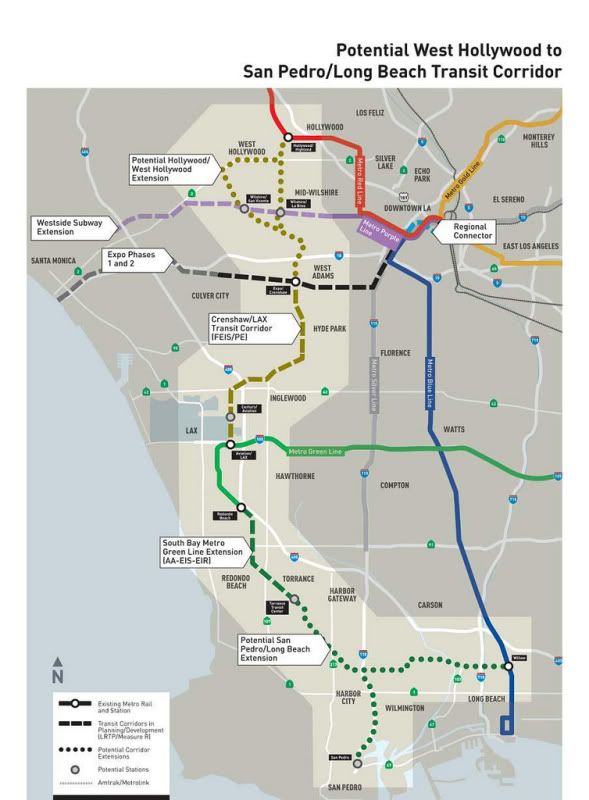
A few things are now certain regarding mass transit in Los Angeles: the subway will be extended as far west as the VA hospital, the Expo Line will be extended to Santa Monica and the Crenshaw Line will connect the Green Line to the Expo Line via LAX. All of these projects are in various phases of approval, funding or construction and are likely to be completed sometime in the next 5-15 years, assuming the Mayor's 30-10 plan takes hold in the new Congress.

Since Metro chose not to include a transfer structure at Wilshire and La Cienega to serve a future subway extension into West Hollywood, the options for providing mass transit to West Hollywood residents are limited. The most viable alternative seems to be a northern extension of the Crenshaw Line, which would create a high ridership transfer point with the Wilshire subway before traveling to Hollywood/Highland via West Hollywood. See figure 1 below for route alternatives.
Figure 1
Demand for a mass transit line that serves the Beverly Center, Pacific Design Center, West Hollywood Library (under construction and across the street from the PDC), and Santa Monica Boulevard corridor is incredibly high. We need to double down on our existing and future transit investments (subway, Expo and Crenshaw) and leverage their construction for strategic enhancements to our transit network. Extending the Crenshaw Line northward through West Hollywood makes a lot of sense, for it would not only serve one of the densest and most vibrant cities in the region but it would also improve the connectivity and overall functionality of Los Angeles' expanding transit network.

November 5, 2010

LA River Vertical Campus

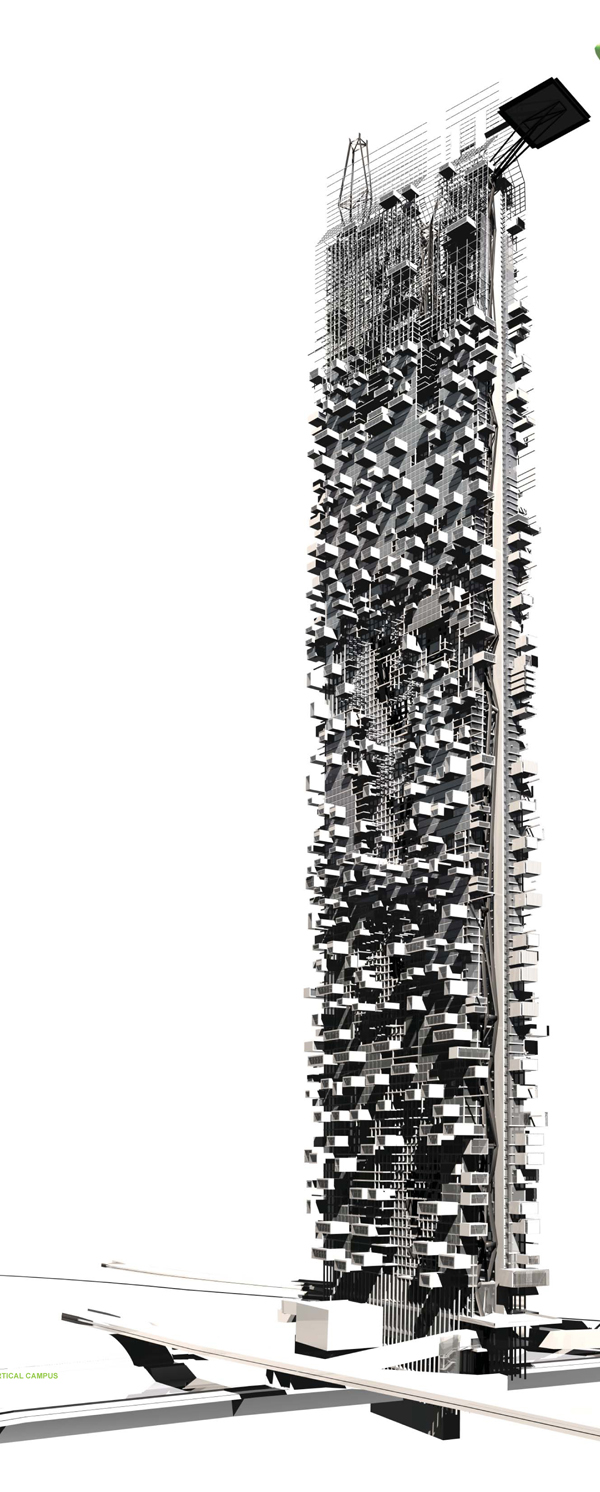
"A starkly modern grid-patterned skyscraper within the heart of Los Angeles, the Vertical Campus, designed by architects Gail Peter Borden and Brian D. Andrews, is a tower that 'engages urbanity,' and seeks to energize and engage the community by re-orienting the landscape from the city’s horizontal sprawl to a vertical complex.

The tower is located over the Los Angeles River, using the building’s base to generate hydroelectricity, and is a mix of residential, commercial, garden and civic spaces.

Instead of just being a skyscraper, though, the Vertical Campus seeks to help re-envision how to unite people through design, how to house new growth in an already dense city, and how to blend complex building systems to unite an existing complex urban fabric. The building will, through its design and also programmatic elements, be a literal bridge that unites the people of different economic and social classes that currently reside on the opposite sides of the river.

Wind turbines join the hydroelectric to provide energy, as does photovoltaic film; horizontal farms breed algae for energy use while hanging gardens grow vegetables and flowers for residents; rainwater is collected and purified; and all of the city’s transportation paths – bike, pedestrian, car, subway, train – run across the building’s base, unifying the building in another way with its landscape." (Source: eVolo)

Using planning and architecture, through thoughtful and provocative design, to connect disparate and geographically isolated socio-economic groups is fundamental to the social sustainability of Los Angeles. At the same time, the tower's use of existing on-site ecological and infrastructural resources, made possible by its near perfect location adjacent the LA River and existing bike, pedestrian and rail connections, make it a model for vertical sustainability and performance-based design.

October 29, 2010

Solar Freeways

A Swedish architect, Mans Tham, proposes covering the nearly 500 miles of freeway in LA County with solar panels. Tham's "Solar Serpents in Paradise" leverage the enormity and urban geography of freeways to produce something positive: locally produced renewable energy that can be fed easily into the existing grid, thereby reducing the need for environmentally destructive solar farms in the desert.
Just covering the 10 freeway from downtown to Santa Monica would produce enough electricity to power all the households in Venice. There is also the potential to provide electric charging stations under freeway over passes and to use the carbon dioxide rich air from the freeway to grow algae on underutilized shoulder space.
Regardless of what one may think of freeways, they are likely to remain part of the built environment for many years to come. But simply denigrating freeways as hulking concrete structures that divide communities and degrade local air quality ignores their potential for becoming part of the sustainability solution. Taking sunken infrastructure investments and repurposing them to serve current needs saves time, money, land and is probably the most effective way for existing urban areas like Los Angeles to transition into a more sustainable future.

October 21, 2010

Decentralized Energy Infrastructure

As electric cars and plug-in hybrids continue to increase their market share in the United States, efforts to decentralize the energy infrastructure for these cars will undoubtedly help make places like Los Angeles more environmentally, economically and socially sustainable. I first introduced the idea of decentralized energy infrastructure in an earlier post, "Greener Cars and Fewer Gas Stations." To understand the point I'm trying make, consider that the fewer of these we need...
Gas station in Los Angeles
...means more land is available for developments like this:
Sierra Bonita affordable housing in West Hollywood
And with more housing and commercial development like Sierra Bonita in the heart of the city means there's less pressure to continue building at the urban fringe.
Sprawl in Santa Clarita
I applaud GM for partnering with Envision Solar to install their solar-powered charging trees at GM dealerships. Each "tree" can generate enough electricity to fully charge one Chevy Volt in a day. Making these charging trees available for private residences is the next logical step to improving the urban landscape in Los Angeles and making the region more sustainable.
Chevy Volt with Envision Solar-Powered Charing "Tree"

October 12, 2010

"Better Block" Project

The Oak Cliff neighborhood in Dallas transformed a tired stretch of street into a vibrant community center by gathering donations from local businesses and putting their DIY attitude to work. Their project is called "Better Blocks" and it's about greening the city and reclaiming streets for people, whether they be on foot, sitting outside a cafe or riding a bike. In 24 hours they were able to turn this:
Into this:
Making Los Angeles sustainable is about more than energy and resources; people and place matter. Reorienting streets for people, as demonstrated here and by the overwhelming success of CicLAvia last weekend, can help produce healthy, vibrant and safe communities that are socially sustainable.

It would be nice to see the enthusiasm generated by CicLAvia translated into an effort, like Better Blocks, to repurpose some LA's widest boulevards into people-based places. Clearly it doesn't take much in the form of resources or time to make a big impact. Use the DIY-model provided by Better Blocks and test-run certain neighborhood streets. Inexpensive and temporary demonstration pilot projects are a great way to generate community and business support, and help justify more expensive and permanent infrastructure investments later on. This approach may not be successful everywhere but with so little capital and time needed to implement a pilot program, the City has little reason not support such an effort.

Which streets would you like to see LA turn into "Better Blocks"?

October 7, 2010

CicLAvia this Sunday - 10/10/10


Check out the street map here. The event is this Sunday, from 10am - 3pm. Enjoy a car-free Sunday in LA!