Showing posts with label energy infrastructure. Show all posts

June 27, 2011

Water Wise House in Mt. Washington

Mt. Washington Home. Source: LA Times
"Those who follow sustainable design say the new residence could very well be one of the most water-efficient houses in the region, a milestone for L.A. as the city seeks better models of conservation. The Nob Hill Haus, as its owner-designers call it, could serve as a template for the house of the future here." (Click here for a link to the full LA Times story.)
Laundry, bath, and sink water flows into this tank before traveling through perforated underground pipes that feed plants. Source LA Times
Partners Frank Pasker and Grit Leipert "let California's scarcity of two resources — power and water — shape the design philosophy for" their new 2,400 square foot Mt. Washington home, which is designed to reduce energy and water consumption to the greatest extent possible. The couple's ultimate goal is to make it a net-zero energy home.

The Los Angeles region is poised to grow considerably over the next couple decades and a similar "design philosophy" is needed for the region to grow sustainably. Climate scientists predict drier and shorter Sierra winters, which means less water for Southern California. As Pasker points out, "California challenges you to do something because of the climate...You want to work with the climate, not against it." Working with the climate, with a particular focus on energy and water, will become the hallmark of successful sustainable design and help shape the future of development in Southern California.
Composting Bins. Souce: LA Times

Green Credentials:
  • Gravity fed grey water system with no pumps, filters or electrical devices
  • Grey water system treats 160 gallons of water per day, which then waters the yard through a series of underground perforated pipes
  • 1,500 gallon cistern used to capture rainwater and water backyard plants
  • 50% water use reduction from the typical Los Angeles home
  • 120 gallon roof-mounted solar water heater
  • 50% thicker walls than required to reduce heating/cooling needs
  • 3.2 kilowatt solar array designed to offset any electricity use

1,500 gallon cistern, which holds captured rainwater for plant watering. Source LA Times

April 14, 2011

Convert Plastic Into Oil

Akinori Ito developed a machine that converts plastic into oil. Watch the video.

March 19, 2011

Parking Lots as Solar Farms

There are ways to transform surface parking lots, which are altogether too numerous in Los Angeles, from an eyesore into a resource. Surface parking lots can be planted with "solar groves" - rows of solar panels - that generate electricity for immediate use (electric charging stations) or provide renewable energy for the grid. 
Retrofitting existing parking lots is not terribly difficult and parking capacity is unaffected. In fact, providing electric vehicle owners with a simple and affordable way to recharge their cars while in the office or while out running errands will reduce "range anxiety" and provide the infrastructure needed to make electric vehicles a viable alternative to gas cars. You can read more about "solar groves" here.

February 8, 2011

"Hedonistic Sustainability"

METROPOLIS published an article online recently on incorporating activity and pleasure into sustainable technologies. Drawing sustainability out of the realm of science and placing squarely into peoples' lives is essential for building public support and expanding our expectations for how sustainability ought to interact with the built environment.
Leave it to Bjarke Ingels to win a competition for his proposal for a new waste to energy plant by designing a 31.000 m2 ski slope. The competition, which yielded 36 proposals in fall 2010, was the largest environmental initiative in Denmark. With a budget of 3.5 Billion DKK, competing teams designed structures to replace a 40- year-old Amagerforbraending plant in Copenhagen with a more sustainable waste energy plant. 
Bjarke Ingels Group (BIG) decided to approach their design in a way that truly celebrates the idea of sustainability. What they call “hedonistic sustainability,” refers to design that improves the quality of life, both directly and indirectly- ecologically and socially.
Physical exercise and fresh air are rarely associated with waste treatment plants. But here the ski slope reaches out to citizens and gives them a new recreational facility, even as it creates a new relationship between waste plant and city. It shows a connection between shaping a healthy future and disposing waste. And it employs the latest technologies in waste treatment, while focusing on environmental performance. This is not a hidden, isolated, utility structure, but a celebration of health and well being. 
BIG really topped itself this time. While the firm’s buildings continue to be green, innovative, and never fail to surprise, here they propose the ultimate in sustainability. The ski slope, made from recycled materials, sits atop a building wrapped in a green facade formed by plant modules. Beneath this living skin are new waste management and energy management technologies. This building takes the idea of mixed use to a whole new level. Shouldn’t all our buildings strive to do the same?
In Los Angeles, like most cities, sustainable practices are integrated into things like building design or streetscape improvements but rarely is the sustainable technology itself the focus of the design exercise. Ingels' design forces us to rethink our understanding of "sustainability" and conceive of new ways in which Los Angeles could leverage sustainable technologies (like waste to energy plants) as cultural and social resources. Creating a symbiotic relationship among these concepts can advance the sustainability of the region while also adding to its vitality and livability.

December 20, 2010

Integrating Sustainability into Bus Shelter Design

Bus stations provide an open platform for layering multiple sustainable technologies in a single location. Installing photovoltaic panels on top of bus shelter canopies is one of the most common practices of sustainable bus shelter design. Some cities are also beginning to explore the possibility of using bus shelters to capture and manage storm water.
Solar-powered bus shelter in San Francisco
San Francisco is in the process of rolling out 1,100 new bus shelters that use roof top solar panels to run lights and power an on-site wifi network, which has the potential to provide significant coverage when expanded citywide. The creative repurposing of bus shelters as a platform for advancing environmental and social sustainability goals holds tremendous promise and is an area that is likely to see further innovation, particularly as bus rapid transit lines like the Orange Line (and future Wilshire Line) continue to attract riders.
Solar panels on bus shelter canopy in San Francisco
To understand the potential for leveraging bus shelters as a way to advance sustainability in Los Angeles, consider that Metro operates 15,967 bus stops throughout its service area. If the transit authority built bus shelters similar to those being used in Corona, which use roof top solar panels to feed 1,748 kilowatt-hours of electricity per year into the grid, it could generate roughly 27,910,316 kWh per year of energy. That's enough energy to power approximately 4,560 homes.

15,967 bus stops x 1,748kWh/bus stop = 27,910,316 kWh
27,910,316 kWh/6,120 kWh per LADWP res. customer = 4,560 households

With nearly sixteen-thousand bus stops in the Metro system, there's a tremendous opportunity to use these sites for producing renewable energy, showcasing local artists and providing other socially valuable services like wifi or way-finding information. Given DWP's target for renewable energy production (35% by 2030), the demand for renewable energy in Los Angeles is high and as local capacity for renewable energy production increases, there is less need for running expensive high powered transmission lines through sensitive environmental habitat.

Clearly Los Angeles could be doing more to deploy its own contextually sensitive design for sustainable bus shelters and leverage such a program to advance additional co-benefits for the region: "green" its transportation system, decrease carbon dioxide emissions, reduce storm water runoff, create jobs for the manufacturing and installation of new sustainable bus shelters, expand free wifi coverage, showcase local arts and culture, and enhance the dissemination of important public information.

Sources:

November 19, 2010

Mayor Wants to Make Homes EV Ready in 7 Days

While at the 2010 LA Auto Show, Mayor Villaraigosa announced that Los Angeles would streamline the permitting process so that owners of electric cars can have charging stations installed in just seven days. DWP is launching a customer hotline (800-342-5397) and the City created a new website (https://www.permitla.org) to expedite the permitting process.

As I argued in an earlier post, "not only have we dedicated enormous tracts of land to cars in the form of freeways and 6 lane roads, but auto-related infrastructure like gas stations also consume valuable real estate that would be much more productive as housing or neighborhood commercial/retail." De-centralizing the infrastructure needed to "refuel" cars will make it possible to re-appropriate gas stations for uses that are more socially, environmentally, culturally and economically sustainable and productive.

However, it would be nice to see the Mayor find a way to consolidate all of the city's numbers/websites and provide the public with a single, easy to use portal for accessing city-related information and resources. The good intentions of the city are often obscured by an overly cumbersome bureaucracy that makes obtaining permits, approvals, filing complaints or finding information a frustrating process. Streamlining the process for getting an electric car charging station installed in your home is great but I doubt many will hear about the Mayor's announcement, and those that do won't know where to look to find the hotline or website.

November 5, 2010

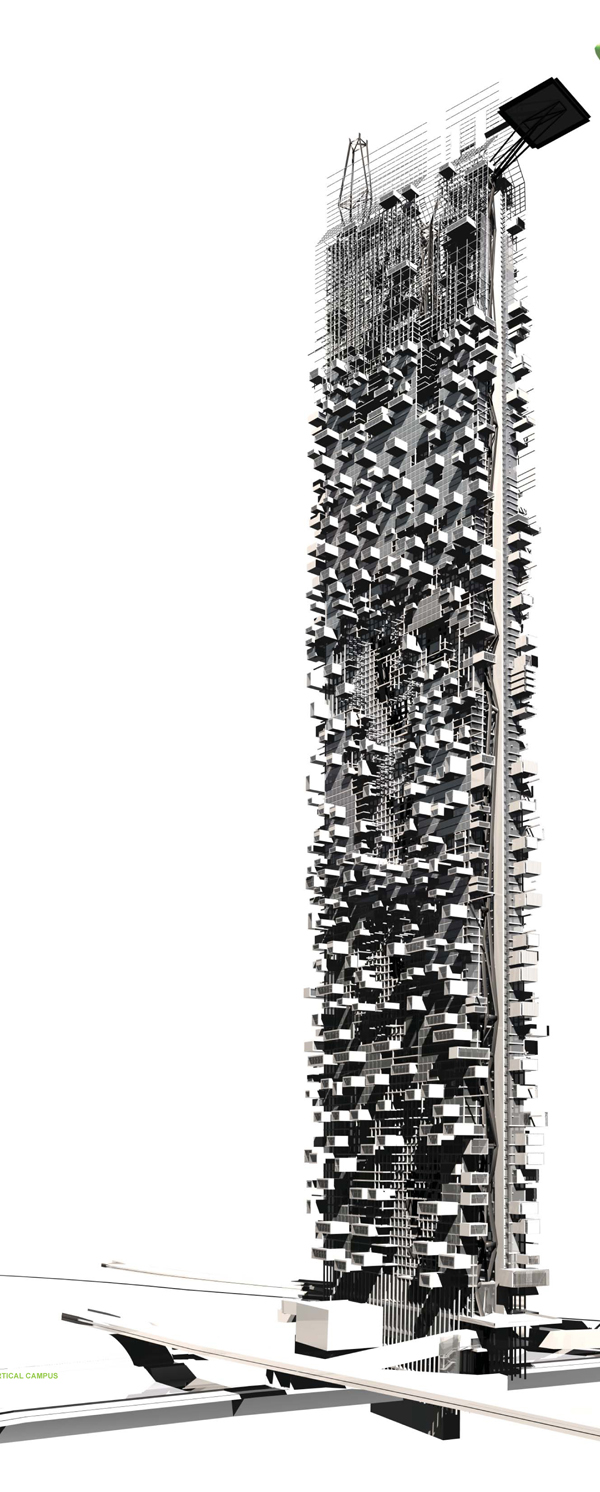
LA River Vertical Campus

"A starkly modern grid-patterned skyscraper within the heart of Los Angeles, the Vertical Campus, designed by architects Gail Peter Borden and Brian D. Andrews, is a tower that 'engages urbanity,' and seeks to energize and engage the community by re-orienting the landscape from the city’s horizontal sprawl to a vertical complex.

The tower is located over the Los Angeles River, using the building’s base to generate hydroelectricity, and is a mix of residential, commercial, garden and civic spaces.

Instead of just being a skyscraper, though, the Vertical Campus seeks to help re-envision how to unite people through design, how to house new growth in an already dense city, and how to blend complex building systems to unite an existing complex urban fabric. The building will, through its design and also programmatic elements, be a literal bridge that unites the people of different economic and social classes that currently reside on the opposite sides of the river.

Wind turbines join the hydroelectric to provide energy, as does photovoltaic film; horizontal farms breed algae for energy use while hanging gardens grow vegetables and flowers for residents; rainwater is collected and purified; and all of the city’s transportation paths – bike, pedestrian, car, subway, train – run across the building’s base, unifying the building in another way with its landscape." (Source: eVolo)

Using planning and architecture, through thoughtful and provocative design, to connect disparate and geographically isolated socio-economic groups is fundamental to the social sustainability of Los Angeles. At the same time, the tower's use of existing on-site ecological and infrastructural resources, made possible by its near perfect location adjacent the LA River and existing bike, pedestrian and rail connections, make it a model for vertical sustainability and performance-based design.

October 21, 2010

Decentralized Energy Infrastructure

As electric cars and plug-in hybrids continue to increase their market share in the United States, efforts to decentralize the energy infrastructure for these cars will undoubtedly help make places like Los Angeles more environmentally, economically and socially sustainable. I first introduced the idea of decentralized energy infrastructure in an earlier post, "Greener Cars and Fewer Gas Stations." To understand the point I'm trying make, consider that the fewer of these we need...
Gas station in Los Angeles
...means more land is available for developments like this:
Sierra Bonita affordable housing in West Hollywood
And with more housing and commercial development like Sierra Bonita in the heart of the city means there's less pressure to continue building at the urban fringe.
Sprawl in Santa Clarita
I applaud GM for partnering with Envision Solar to install their solar-powered charging trees at GM dealerships. Each "tree" can generate enough electricity to fully charge one Chevy Volt in a day. Making these charging trees available for private residences is the next logical step to improving the urban landscape in Los Angeles and making the region more sustainable.
Chevy Volt with Envision Solar-Powered Charing "Tree"