Showing posts with label Los Angeles River. Show all posts

November 5, 2010

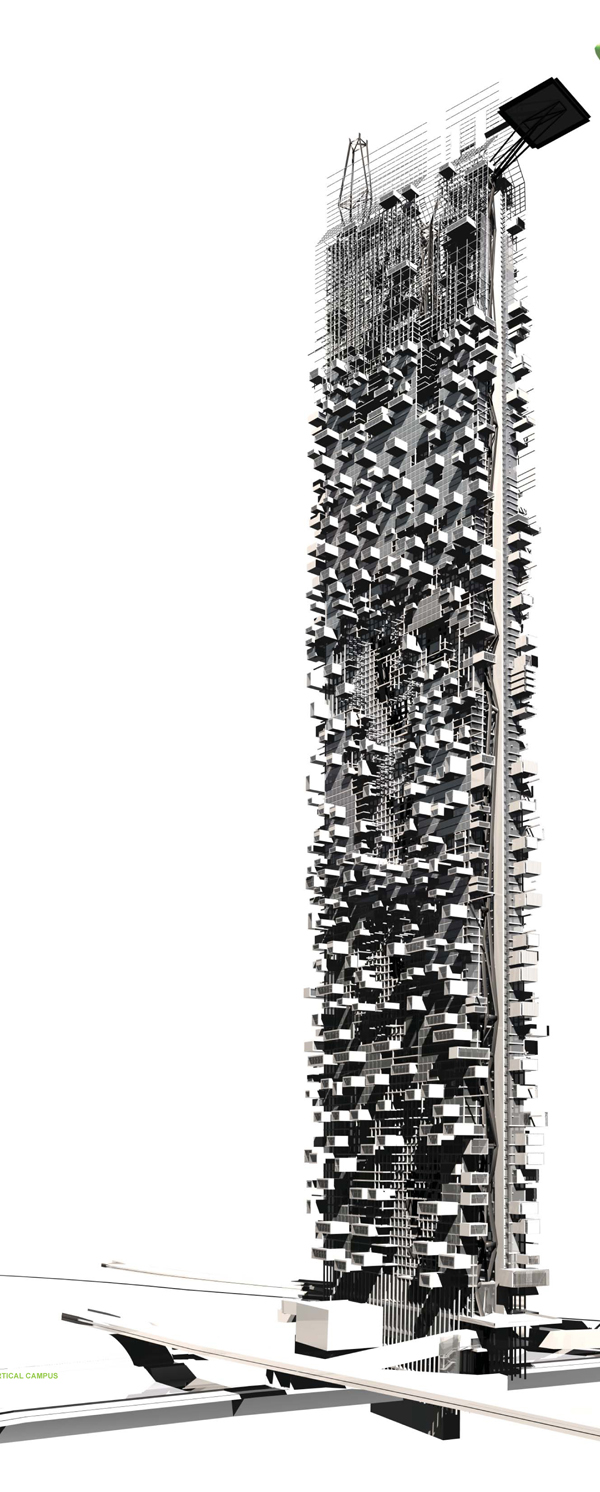
LA River Vertical Campus

"A starkly modern grid-patterned skyscraper within the heart of Los Angeles, the Vertical Campus, designed by architects Gail Peter Borden and Brian D. Andrews, is a tower that 'engages urbanity,' and seeks to energize and engage the community by re-orienting the landscape from the city’s horizontal sprawl to a vertical complex.

The tower is located over the Los Angeles River, using the building’s base to generate hydroelectricity, and is a mix of residential, commercial, garden and civic spaces.

Instead of just being a skyscraper, though, the Vertical Campus seeks to help re-envision how to unite people through design, how to house new growth in an already dense city, and how to blend complex building systems to unite an existing complex urban fabric. The building will, through its design and also programmatic elements, be a literal bridge that unites the people of different economic and social classes that currently reside on the opposite sides of the river.

Wind turbines join the hydroelectric to provide energy, as does photovoltaic film; horizontal farms breed algae for energy use while hanging gardens grow vegetables and flowers for residents; rainwater is collected and purified; and all of the city’s transportation paths – bike, pedestrian, car, subway, train – run across the building’s base, unifying the building in another way with its landscape." (Source: eVolo)

Using planning and architecture, through thoughtful and provocative design, to connect disparate and geographically isolated socio-economic groups is fundamental to the social sustainability of Los Angeles. At the same time, the tower's use of existing on-site ecological and infrastructural resources, made possible by its near perfect location adjacent the LA River and existing bike, pedestrian and rail connections, make it a model for vertical sustainability and performance-based design.

August 4, 2010

LA River - The Spine of the City

There's been a lot of positive press about the LA River recently. GOOD and the LA Times ran stories recently discussing the EPA's decision to officially designate the LA River a "traditional navigable waterway," which apparently paves the way for federal money to be put toward restoring the river to a semi-natural condition. This is great news and a positive first step to undo the concrete channelization of the river and realize the potential of the waterway put forward by the LA River Master Plan.

And projects like the one on Elmer Avenue in Sun Valley (part of LA's Green Streets Initiative) will enable the naturalization of the LA River to occur by capturing and retaining stormwater on-site, reducing peak flow in the river channel during heavy storm events. Greening LA's streets also holds tremendous potential for reducing the city's reliance on distant sources of water. Local acquifers could be replenished through on-site stormwater retention techniques, making more water locally available for use. (note: about 19% of California's carbon dioxide emissions come from pumping and transporting water throughout the state).
Model of a proposal to redevelop an existing train yard into open space and housing.

A much bolder plan to naturalize a portion of the LA River was unveiled last month. Friends of the LA  River (FoLAR), together with a team of advisors, put together a proposal to turn 130 acres of industrial land into a verdant development with open space, housing, commercial and retail thoughtfully integrated into a lush riparian setting that reconnects the landscape with the existing fabric of the city. It's a bold proposal sure to draw fire and attention from all sides. At first glance, it appears to kiss the ring and pay homage to the easiest to achieve and least controversial principles of sustainability. A more critical assessment will have to wait until the details of the project become clearer but for now it's focus on water, neighborhood connectivity, transit, mixed-uses, recreation, open space and agriculture is comprehensive in scope and holistic in approach. A laudable project to be sure. There is plenty more to read here and I encourage you to do so. Become involved in the discussion by commenting on their site or this blog.